

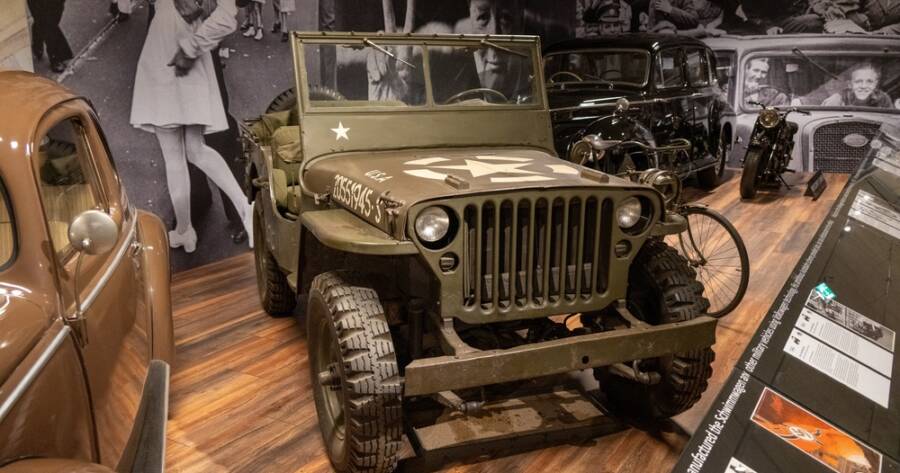
Military surplus Jeeps combine collectible value with some of the most recognizable vehicle history of the 20th century. From WWII-era Willys MB and Ford GPW models to postwar M38s and later military utility vehicles, surviving examples vary enormously in rarity, originality, condition, and price. Knowing the major models and what collectors value can make the market much easier to understand.
The Origins of the Military Jeep
The story of the military Jeep begins with urgency. As the United States prepared for potential involvement in World War II, the Army needed a lightweight, versatile reconnaissance vehicle capable of handling rugged terrain. Three manufacturers answered the call: American Bantam Car Co., Ford, and Willys-Overland. Each company submitted a prototype, and while Bantam managed to produce a vehicle remarkably close to the required specifications in just 45 days, the company lacked the production capacity to fulfill the Army’s needs (source).
The final production design drew from the best qualities each manufacturer had demonstrated. Both Ford and Willys ultimately built Jeeps at scale, and the two resulting models, the Ford GPW and the Willys MB, were so similar in construction that roughly 90 to 95 percent of their components were interchangeable (source). Ford produced 281,448 units during the war, Willys contributed 362,841, and Bantam accounted for 2,675 vehicles (source).
Post-WWII Military Jeep Models
Following the war, the military continued to refine its light utility vehicle lineup. Willys introduced the M38 between 1950 and 1952, producing more than 45,000 units of this model, also known as the MC. The M38 featured a distinctive one-piece windshield and headlights that protruded with protective bars around them (source). This model represented the first significant step away from the wartime Jeep design toward a purpose-built postwar military vehicle.
Willys-Overland followed the M38 with the M38A1 in 1952, a model that introduced the F-head “Hurricane” engine and adopted curved fenders that gave the vehicle a noticeably rounder appearance compared to its predecessor (source). Combined U.S. and foreign military sales of the M38A1 surpassed 100,000 units. A particularly unusual variant was the M38A1D, which was configured to carry the Davy Crockett tactical nuclear weapon system. Jeep’s own historical archive notes that the M38A1D could be equipped with the launcher used to fire a nuclear-capable projectile, making it one of the most distinctive military adaptations of the M38A1 platform (source).
The M151 MUTT, short for Military Utility Tactical Truck, became the successor to earlier military Jeep-style vehicles and served across every branch of the U.S. military. Ford began producing the improved M151A2 in 1969, and AM General continued U.S. military production from 1971 through 1985. The HMMWV began replacing the M151 in 1985, although some variants remained in service for years afterward (source).
Rare and Specialty Variants
Among the more unusual entries in the military Jeep lineage, the Ford GPA stands out as a particularly rare example. Ford produced 12,778 of these amphibious Jeeps before the contract concluded in 1943, and surviving examples in excellent condition have sold for over $150,000 (source). The Bantam BRC-40 is even rarer, as only 2,675 of these early prototypes were supplied to the Army for testing in early 1941. A fully restored BRC-40 can command prices exceeding $60,000 due to its scarcity and historical importance (source).
Another unusual vehicle often grouped with military Jeeps is the AMC M422 Mighty Mite. Built for the U.S. Marine Corps, the lightweight four-wheel-drive vehicle entered production around 1959 and remained in production through 1962. AMC produced 1,250 original M422s and another 2,672 stretched M422A1 models, for a total of 3,922 vehicles (source).
Civilian Ownership and the Collector Market
One aspect of military surplus Jeeps that surprises many people is the legality of private ownership. Civilians are fully permitted to own vintage military Jeeps, a fact that has supported a thriving collector market for decades (source). Restored examples range considerably in value depending on rarity and condition. A restored M38 typically sells in the range of $14,500 to $19,500, while the more common M38A1 commands $12,500 to $18,000 when brought back to original condition (source).
Collectors are drawn to these vehicles for numerous reasons. Some pursue the historical connection to major military conflicts, while others appreciate the mechanical simplicity that makes restoration and maintenance manageable. Because parts between the Ford GPW and Willys MB are nearly universally interchangeable, sourcing components for WWII-era Jeeps remains far more practical than it might be for other vintage vehicles. The collector community surrounding military surplus Jeeps is deeply knowledgeable, and restoration standards vary from fully original configurations to sympathetically modernized builds that preserve appearance while improving reliability.
Why You Should Learn More About Military Surplus Jeeps Today
Military surplus Jeeps represent more than transportation; they are tangible connections to pivotal moments in American history. From the Bantam prototypes that sparked an entire vehicle category to the long-serving Ford M151 that carried troops through decades of Cold War service, each model tells a distinct story.
Whether someone is drawn by collector interest, mechanical curiosity, or a passion for military history, these vehicles offer layers of significance that few other surplus items can match. Understanding the differences between models, their production histories, and what drives current market values is essential knowledge for anyone considering entering this rewarding space.