

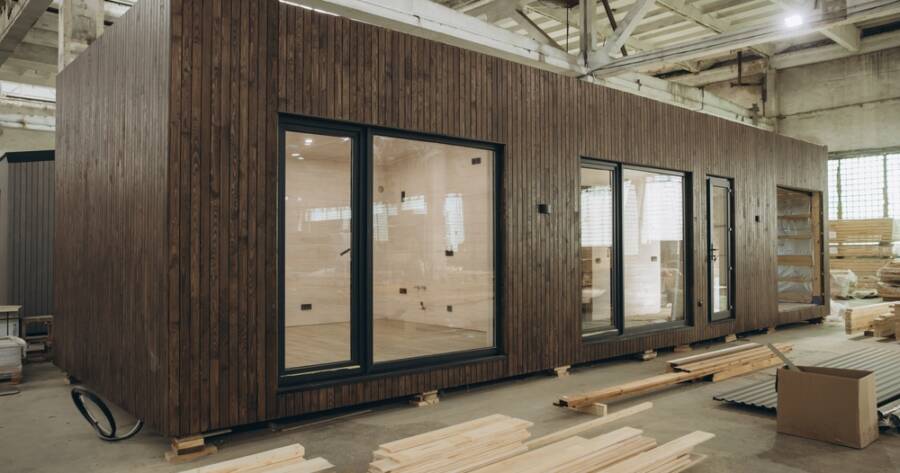
Small modular homes offer an alternative to traditional home construction for Americans seeking manageable living spaces and potentially lower housing costs. Built largely in factories before being assembled on permanent foundations, modular homes can combine efficient construction methods with customizable designs. Understanding construction standards, total project expenses, and available features can help buyers determine whether a small modular home makes financial and practical sense.
What Makes Small Modular Homes Different?
Modular homes are constructed in sections inside a factory, transported to a building site, and assembled into a finished residence. Unlike manufactured homes, which are governed by federal HUD construction standards, modular homes generally follow state or locally adopted building codes similar to those applicable to conventional houses (source).
Factory construction offers several potential advantages. Materials can be protected from prolonged weather exposure, production schedules may be easier to coordinate, and standardized building processes can reduce certain inefficiencies. Because smaller homes require less living space, buyers may also be able to simplify layouts and reduce the amount of material needed for construction.
However, modular construction does not eliminate on-site work. Foundations, utility connections, structural assembly, and finishing tasks still require planning and qualified contractors.
How Affordable Are Small Modular Homes?
Small modular homes can offer a more manageable entry point into homeownership, but prices depend heavily on square footage, finishes, and the manufacturer. For example, U.S. modular-home builder ideabox currently lists its 442-square-foot blox studio starting at $190,000, its 533-square-foot piccolo model at $225,000, and its 781-square-foot haven model at $262,000. Buyers seeking additional space can consider the company’s 917-square-foot confluence model, which starts at $284,000 (source).
These prices represent the factory-built homes rather than complete residential projects. Additional expenses include transportation, foundations, permits, utility connections, and installation. As an illustration, ideabox estimates that the home itself accounts for approximately 63% of a typical project budget, with site work, transportation, and installation making up the remainder. Actual proportions vary according to the property and construction requirements (source).
Buyers should therefore request comprehensive estimates before comparing modular homes with traditional construction. A lower advertised price does not necessarily translate into lower overall housing costs, particularly when land acquisition or extensive site preparation is required.
Choosing a Small Floor Plan That Works
A compact home can feel spacious when its layout reflects the occupants’ daily routines. Open living areas, strategically placed windows, and built-in storage can make limited square footage more functional without requiring elaborate architectural features.
Buyers should consider how many bedrooms they genuinely need, whether a separate workspace is necessary, and how much storage their household requires. Combining dining and living areas may free up valuable space, while closets extending toward the ceiling can help reduce clutter.
Accessibility deserves attention as well. Single-story layouts, wider doorways, and bathrooms designed for easier movement may appeal to older buyers planning to remain in their homes long term. Choosing these features during the design stage can be more convenient than modifying the property later.
Energy Efficiency and Long-Term Savings
Small modular homes can offer opportunities for lower energy consumption, particularly when their compact size is combined with appropriate insulation, efficient windows, and well-designed heating and cooling systems.
However, factory construction alone does not guarantee strong energy performance. Buyers should examine insulation specifications, air-sealing methods, ventilation systems, and the efficiency of installed equipment.
One useful benchmark is ENERGY STAR certification. Eligible modular homes can qualify under the program’s single-family construction requirements, which involve energy-performance standards and independent verification (source).
Ask manufacturers for documentation supporting their efficiency claims, including any certifications and details about heating and cooling equipment. Comparing these specifications can help buyers identify models with the potential to reduce ongoing energy expenses rather than focusing exclusively on the purchase price.
Building Codes, Permits, and Installation Requirements
Before ordering a small modular home, buyers must confirm that their chosen property allows the proposed construction. Local zoning restrictions may regulate building size, setbacks, height, and permitted residential uses.
Building approvals and inspections are equally important. Depending on the state, modular sections may undergo factory inspections, while foundations, assembly, and other site-specific components require additional approvals.
Buyers should also review manufacturer warranties, contractor responsibilities, delivery arrangements, and expected construction milestones. Establishing these details in writing can help prevent disputes and unexpected expenses.
Is a Small Modular Home Worth Considering?
Small modular homes can be attractive to first-time buyers, downsizers, and people seeking simpler living arrangements. Their potential advantages include efficient factory production, adaptable layouts, and opportunities for lower operating expenses.
The strongest purchasing decision comes from comparing complete project costs, construction quality, energy specifications, and local requirements. Rather than assuming every modular home is automatically cheaper or more efficient, buyers should evaluate individual models carefully. With realistic budgeting and thoughtful design choices, a small modular home can provide comfortable, practical housing without unnecessary space or expense.